




Pick up a shaft spec sheet and the numbers look simple: a model name, a flex, a weight. Compare two sources for the same shaft, though, and they often disagree. We found out how often the hard way. At FitMyGolfClubs, the app grades a golfer's whole bag on specs alone, so every shaft weight in our database feeds straight into someone's grade. So we audited all of it: roughly 3,000 shaft specs, checked for duplicates, with the most common families (Nippon, Project X, Graphite Design, Mitsubishi) checked line by line against the published manufacturer and retailer spec tables. We deleted 94 entries that were duplicates or described shafts that were never made.
Here is what the audit turned up. If you have ever wondered why your "120-gram" shaft doesn't weigh 120 grams, this is why.
1. The number on the shaft is a class, not a weight
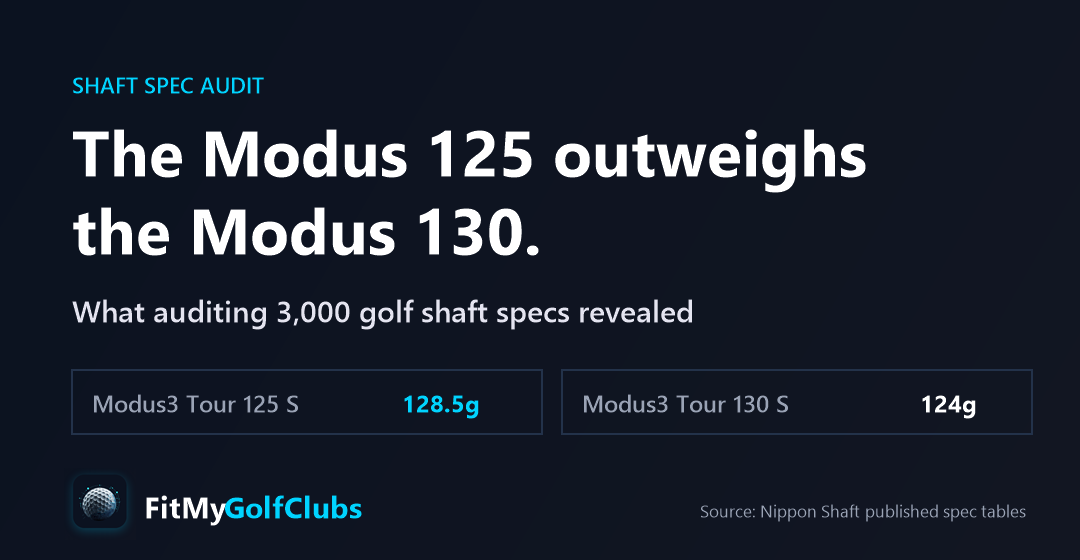
Nippon's N.S. Pro Modus3 Tour line is the clearest example. Most golfers assume a Modus 130 is heavier than a Modus 125. Nippon's own spec tables say otherwise:
Model | R | S | X |
|---|---|---|---|
Modus3 Tour 105 | 103g | 106.5g | 112g |
Modus3 Tour 115 | 117.5g | 118.5g | 119.5g |
Modus3 Tour 120 | 111g | 114g | 120g |
Modus3 Tour 125 | 127.5g | 128.5g | 129.5g |
Modus3 Tour 130 | 121g | 124g | 129g |
The Tour 125 outweighs the Tour 130 at every flex, and the Tour 115 outweighs the Tour 120 in regular and stiff. The number describes a profile family, not the grams in your hand. Our full Nippon Modus shaft chart has every model, including the GH lightweight line and Zelos.
2. Some "specs" describe shafts that never existed
Project X IO is sold in three flexes: 5.5 at 105g, 6.0 at 110g and 6.5 at 115g. It was never made in 5.0. Yet a 5.0 IO turned up in our data, carried over from an import, and six independent retailer and review sources agreed it doesn't exist. Project X LS had the same problem: it comes only in 6.0, 6.5 and 7.0, at roughly 120, 125 and 130 grams, but our data held a 5.0 and a 5.5.
That matters more than it sounds. If you tell a fitting tool you play a "Project X IO 5.0," the only sensible reading is that you have the 105-gram IO, which is a 5.5, one flex firmer than you think.
3. One model name, three different weights
"Project X 6.0" means very different shafts depending on the model:
Project X (original steel) 6.0: 121g, usually listed as 120g
Project X LZ 6.0: 120g
Project X IO 6.0: 110g
If a used-club listing says "Project X 6.0, 110g," it is almost certainly the IO. The full ladder, from 5.0 at 113g to 7.0 at 130g, is in our Project X shaft weights and specs chart.
4. Spelling creates phantom shafts
The quietest source of error was plain spelling. "N.S. Pro Modus 3 Tour 105," "NS Pro Modus3 Tour 105" and "Modus3 Tour 105" are the same shaft. When data arrives from different retailers and club makers' pages, each spelling can become its own entry, each carrying a slightly different weight. One of these duplicates listed the same 107-gram weight for regular, stiff and extra-stiff, which no real shaft does. We now fold those spellings together before matching.
Why a few grams matter
Five grams sounds trivial. But shaft weight should step up in a steady progression from driver to wedges, and your irons should feel like a matched set. A mistake of 5 to 10 grams can make a set that is actually consistent look out of order, or hide a real gap. Our golf shaft weight guide explains how weight and flex work together, and the swing speed shaft flex chart shows which flex fits which speed.
How to check your own shafts
Read the full label. Write down the brand, the model line and the flex code exactly as printed, for example "Modus3 Tour 120 S," not just "Modus S."
Look up the manufacturer's table, not a retailer summary. Nippon, True Temper and KBS all publish weight-by-flex tables.
Check the progression. Your iron shafts should match each other, your wedge shafts should be the same weight or slightly heavier, and your woods should be lighter.
If something doesn't add up, start with the model, not the flex. Most "wrong weight" puzzles turn out to be a different model with the same number.
If you'd rather not do it by hand, FitMyGolfClubs grades your whole bag across eight fitting factors, shaft weight and flex progression among them, from the specs of the clubs you already own. No launch monitor or fitting appointment is needed, and it's free to start. There's also a set of free golf club fitting tools, including a swing-speed flex calculator.
Sean Morrissey is the founder of FitMyGolfClubs and a golf professional.