




For centuries, humans have made metal objects by heating them, hammering them, pouring molten material into molds or carving away everything that doesn't belong.
Swords. Engines. Surgical instruments. Golf clubs.
The technology has become extraordinarily sophisticated, but the fundamental idea hasn't changed much; start with metal, then shape it into something useful.
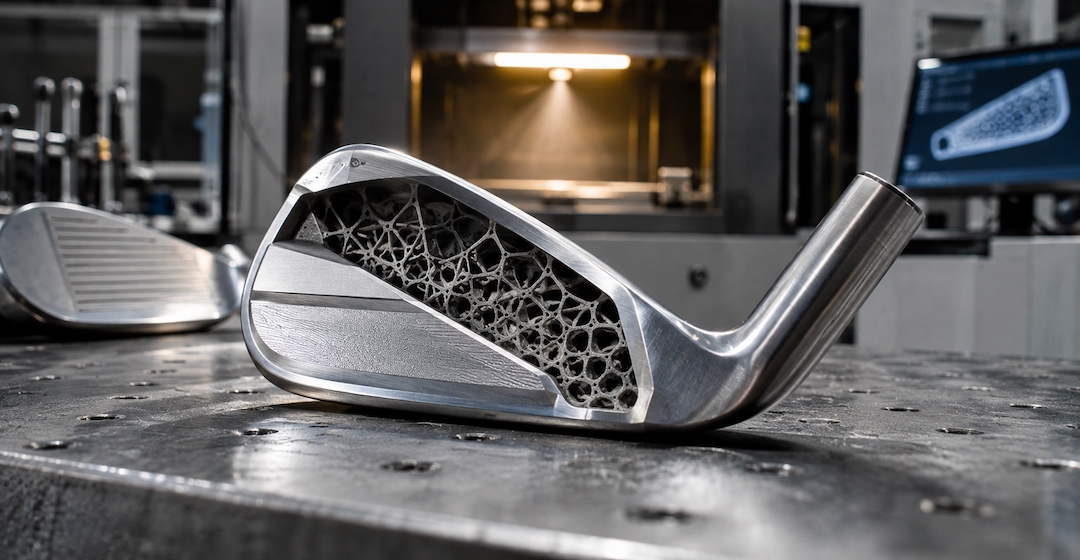
Now imagine building a golf club the way nature builds a skeleton. Not as a solid chunk of metal, but as an intricate network of microscopic structures, engineered to be strong where strength matters and nearly weightless everywhere else; structures so complicated that no traditional forging process could produce them.
But this isn't some distant laboratory experiment; this the new reality.
In early November, Callaway Golf announced a $15-million investment in a dedicated 3D-printing facility in Fort Worth, Texas as the company believes additive manufacturing could unlock some of the biggest advances in golf equipment in decades.
The announcement also represents something more interesting than another manufacturing investment; it signals that golf clubs are beginning to escape the physical limitations of how they've always been made.
The Clubhead Is Becoming a Computer-Generated Structure
Traditional golf clubs are generally manufactured through casting, forging, machining or combinations of those processes, as engineers have become remarkably good at manipulating materials, adjusting weight distribution and designing increasingly sophisticated clubheads.
But there's a catch as a design is only useful if somebody can actually manufacture it.
Imagine trying to carve a complex honeycomb structure inside a sealed titanium clubhead. Conventional tools can't easily reach the interior, and traditional manufacturing methods impose limits on the shapes engineers can create.
Metal 3D printing approaches the problem from the opposite direction.
Instead of removing material from a solid block, an industrial printer builds an object layer by layer, using precisely controlled energy to fuse metal powder into the desired geometry.
The result can be an incredibly complicated structure that exists first as a digital design and then becomes a physical object—think aerospace components, medical implants and lightweight structures engineered for extreme conditions—and now apply those principles to a golf club.
Callaway's new Texas facility will focus on advanced titanium manufacturing, building on approximately seven years of research and internal prototype production dating to late 2022.
The facility is expected to become operational in mid-2027 and begin supporting some U.S. product needs in 2028, initially concentrating on custom titanium products.
The investment signals that 3D printing is moving beyond experimentation toward a potentially important role in commercial golf equipment.
The Secret Is What's Inside
One of the most compelling examples of this technology is already sitting in golf bags.
Cobra introduced its limited-edition LIMIT3D irons in 2024 and expanded its commercially available 3D-printed lineup in 2026.
What makes these clubs remarkable isn't necessarily how they look—it's what you can't see.
Inside the clubhead is an intricate metal lattice, a carefully engineered network of tiny interconnected structures. The lattice provides support while eliminating material that would otherwise contribute unnecessary weight, while that saved weight can then be redistributed to locations where it improves the club's performance.
For example, designers can move mass toward the perimeter of the clubhead, increasing its resistance to twisting when a golfer strikes the ball away from the center.
In golf terminology, that's forgiveness. For everyone else, it's engineering a device to perform more consistently when the human operating it makes a mistake.
Cobra's original LIMIT3D irons used the technology to free substantial weight for strategically positioned tungsten, combining a compact clubhead with performance characteristics usually associated with larger, more forgiving designs.
The fascinating part is that the lattice itself can be engineered for more than weight reduction.
Its geometry can influence stiffness, vibration and even the sound a club makes when it strikes a ball, while the internal architecture becomes another performance variable.
Suddenly, engineers aren't just designing the exterior of a golf club—they're designing its skeleton.
The Software Is as Important as the Printer
There's a misconception that 3D printing is primarily about manufacturing, but the real revolution may be happening on computer screens.
Creating complex internal structures requires computational design tools capable of managing geometries that would be painfully difficult to construct manually.
Cobra worked with engineering software company nTop to develop the lattice structures inside its printed irons.
Instead of individually designing thousands of tiny structural elements, engineers can use software-driven workflows to generate and modify intricate internal architectures.
Change the design parameters, and the software can recalculate the geometry. Adjust the desired stiffness, weight distribution or manufacturing constraints, and a different internal structure becomes possible.
According to nTop, its software helped Cobra reduce development time by approximately a year and this is where golf equipment begins to resemble other advanced engineering disciplines, as the clubhead is no longer simply a shape designed by a person.
It's increasingly a computational structure shaped by mathematical models, simulation and manufacturing software—and that opens intriguing possibilities for customization.
In theory, manufacturers could eventually produce different internal geometries for different golfers without requiring entirely new molds or tooling for every variation.
The technology doesn't make individualized production automatically economical, but it removes some of the manufacturing barriers—and that's a meaningful shift.
The End of the Forged Era? Not So Fast.
Before anyone throws away their favorite irons, there are reasons traditional manufacturing remains dominant.
Metal 3D printing is expensive. Machines require substantial investment, production can be slow, and printed parts often need additional processing, finishing and inspection—a reminder that producing a technically-remarkable clubhead is one challenge, while producing thousands of them economically, consistently and at a price golfers will accept is another.
There's also no guarantee that a printed club will outperform a well-designed forged or cast alternative as performance still depends on engineering, materials, construction and how the club interacts with the golfer.
But the significance of Callaway's investment is that a major equipment manufacturer sees enough potential to commit serious money to the technology's future—and Cobra has already demonstrated that printed metal clubheads can move beyond prototypes and into commercially available products.
For decades, golf equipment innovation has largely involved finding better ways to manipulate familiar materials using familiar manufacturing processes; now additive manufacturing changes the question.
Instead of asking how to improve the golf clubs we already know how to make, engineers can ask what they'd build if traditional manufacturing limitations weren't standing in the way.
The next breakthrough might not be visible when you look down at a clubhead. It could be hidden deep inside, in a structure that couldn't have existed a decade ago—and the most interesting part?
Nobody had to forge it.
The Next Great Golf Club Might Be Impossible to Forge
Golf clubs are entering the 3D-printed era, where complex metal lattices and computational design could create equipment impossible to forge or cast today.

· 4 days ago
Related Articles

Equipment
Do the Proposed Tour Rules Change What’s in Your Golf Bag?

Apparel
+3
Business
Equipment
Products

More Than a Logo: The Family Story Behind the Hazard Hooligans Shield
Apparel
+2
Business
Products

Inside the Signature Series: How Hazard Hooligans Engineered Performance Golf Polos Built for Loud Attitude and Full Athletic Swing
Courses

Affluent Golfer’s The Bigger Game Finds the Shot Before the Shot
Equipment

Golf Shaft Sizing: Why the Right Length Matters More Than the Label
Clubs

Affluent Golfer’s Tasting Room Asks What’s Worth a Second Sip
Business

Affluent Golfer and The Motor Car Society Link Their Editorial Coverage
Apparel
+3
Equipment
Products
Tournaments

Meet Hazard Hooligans: Built in a Garage for Golfers Who Train Hard and Refuse to Blend In
Products

Affluent Golfer Returns With a Holiday Gift Guide for Golfers
Business
+2
Products
Technology
The Next Great Golf Club Might Be Impossible to Forge

Business
+3
Clubs
Courses
Tournaments

How to Bet on Golf: Step-by-Step Beginner's Guide
Clubs

Affluent Golfer Makes the Case for a Longer Clubhouse Lunch
Business

Affluent Golfer Opens the Archive for a Second Look
Business

Affluent Golfer Makes Room for the People Who Skip the First Tee
Courses

Affluent Golfer’s Fairway Finds Looks for a Day Worth the Drive
Products

Affluent Golfer Takes the Guesswork Out of Christmas Golf Gifts
Business

Affluent Golfer Goes Off the Scorecard for the Stories Numbers Miss
Equipment

Affluent Golfer Packs for the Golf Trip Before the First Tee
Business

Affluent Golfer’s The Watch Box Makes Time for the Details
Business

Affluent Golfer Brings Celebrity Covers Back to the Fore with A Round With