







A golfer priced at +400 may look like a strong favorite next to someone at +4000. But those numbers are not performance grades, and they do not tell you how many strokes either player will shoot. They describe the terms of a wager. Once you translate them into implied probabilities, the market becomes easier to read without mistaking price for certainty.
The mathematics is straightforward. Interpreting what it means requires more care.
A Price Is a Statement About a Possible Payout
American odds use a plus or minus sign. A positive number, such as +400, tells you the profit from a hypothetical $100 winning stake. A negative number, such as -125, tells you the stake required to make $100 profit.
Consider a $10 bet at +400. If it wins, the profit is $40, and the total return is $50. If it loses, the $10 stake is gone. A large potential return does not mean the wager is more attractive; it generally reflects a lower priced-in chance of success.
For negative odds of -125, a successful $20 stake produces $16 profit and $36 total return. Golf outrights often display positive odds, while matchups and other markets may include negative prices.
Convert the Number Into an Implied Chance
Positive Odds Use One Fraction
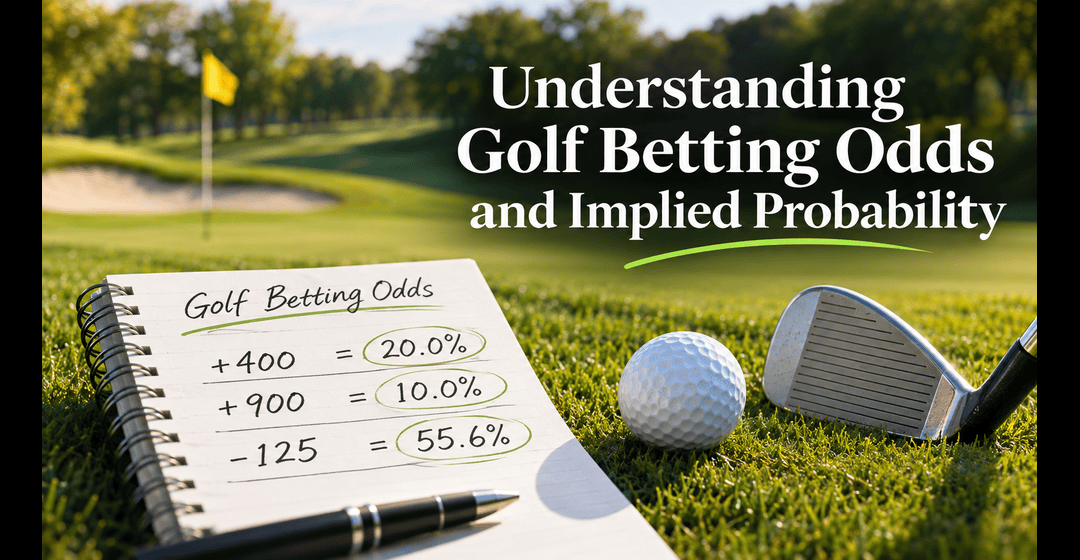
For positive American odds, divide 100 by the odds plus 100. At +400, that is 100 ÷ 500, or 20%. At +900, the result is 10%.
Negative Odds Reverse the Structure
For negative odds, divide the absolute value of the odds by that value plus 100. At -125, the calculation is 125 ÷ 225, or approximately 55.6%.
These figures are implied probabilities. They are not independent forecasts and should not be presented as the golfer's true likelihood of winning.
The Sportsbook Margin Changes the Picture
Imagine a hypothetical two-outcome matchup with both players priced at -110. Each side implies about 52.38%. Add them together, and you get roughly 104.76%, not 100%.
That extra percentage illustrates the bookmaker's margin, sometimes called the overround. The two golfers cannot both win a two-outcome market, but the quoted probabilities contain the cost of the market. In a large outright field, adding the implied probabilities of every available selection can similarly produce a total above 100%.
This is why comparing a quoted probability with your own assessment is not as simple as declaring a favorite underpriced. You need a defensible estimate of the event's actual likelihood, which is difficult to establish.
Why a Short Price Can Still Be a Poor Choice
Suppose a golfer is listed at +200, implying 33.3%. If your carefully developed estimate is 25%, the price would not justify a wager under that estimate. If you believe the chance is 40%, the quoted price might appear favorable, but your model could be wrong.
The important distinction is between probability and confidence. A number with two decimal places may look precise even when the underlying estimate rests on a small sample, incomplete injury information, or weather that could change.
Course history deserves the same scrutiny. One strong finish at a venue is evidence of a past result, not proof that the player will repeat it.
Watch What Happens When Prices Move
A price can shorten from +1000 to +800 as a tournament approaches. The implied probability changes from about 9.1% to 11.1%. That movement does not prove new information has made the golfer better. Books may react to betting activity, revised assessments, lineup news, or broader market movement.
Record the time of any quote and compare like with like. Outright odds and top-10 odds refer to different events, so their implied probabilities cannot be substituted for one another.
For readers who want a wider tour of how odds relate to market types, Pinshot's golf wagering overview provides additional context.
What a Probability Estimate Cannot Tell You?
A single percentage does not capture the full range of uncertainty in a golf tournament. A player's recent form may be based on a handful of starts, and the quality of those fields may differ substantially. Weather can also alter scoring conditions between tee-time waves.
When making your own estimate, record the assumptions rather than presenting the result as a fact. A 30% personal forecast is not automatically superior to a 25% market implication just because it comes from a spreadsheet. Models can be miscalibrated, incomplete, or influenced by the same public narratives they are supposed to test.
The arithmetic is useful precisely because it exposes questions you still cannot answer.
The Most Valuable Calculation Is the One You Question
Odds conversion gives you a common language for comparing prices. It does not solve the harder problem of predicting professional golf. Use implied probability to challenge assumptions, check arithmetic, and recognize the sportsbook's margin rather than to manufacture certainty.
Responsible gambling: Betting involves a real possibility of losing your stake. Follow local law and age restrictions, establish a spending limit, and never treat a probability calculation as a guaranteed path to profit. The National Council on Problem Gambling provides support if betting becomes harmful.