

Four feet is four feet. Unless it's for par on the third hole. Or $20 on the 18th. Or your club championship. The golf ball doesn't know the difference, but your heart does.
For decades, golf technology has been obsessed with what happens immediately after impact. Launch monitors measure ball speed, spin, carry and launch angle. Cameras analyze club delivery. GPS watches calculate distance. Shot-tracking systems determine whether that 7-iron actually travels as far as you insist it does.
But a new generation of golf technology is beginning to investigate something that happens before any of those measurements exist: the golfer.
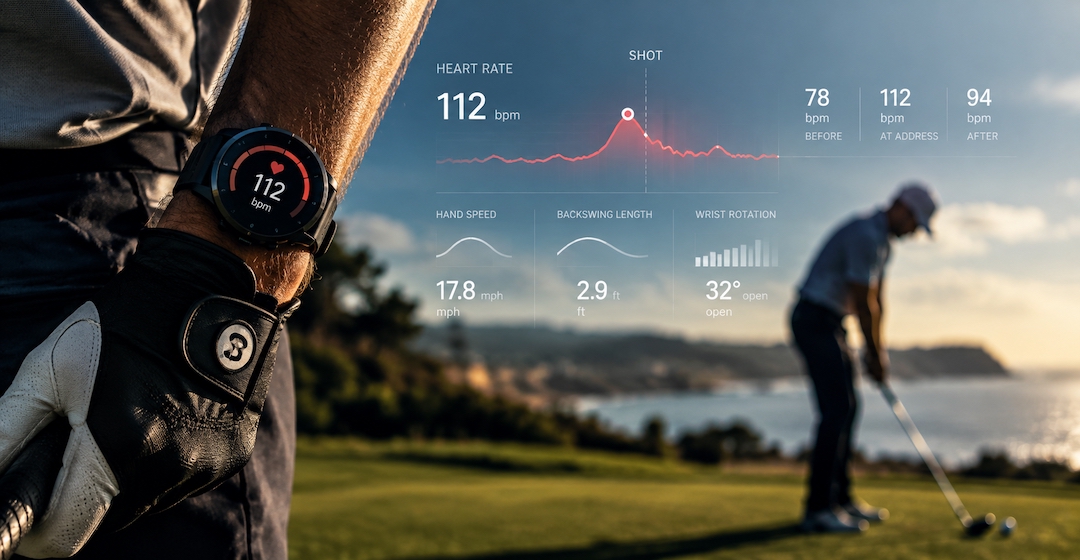
Garmin's new Approach S72 smartwatch—announced this week—includes real-time biometric data that allows golfers to examine changes in heart rate before and after individual shots. After a round, the watch can reveal trends between those physiological changes and scoring.
It's a relatively small feature buried inside a very sophisticated golf watch, but it also hints at something much bigger.
Golf's next important performance dataset may not come from the club or the ball. It may come from the nervous system attached to them.
Golf Has Measured Almost Everything Except You
Modern golf has become spectacularly measurable.
Stand in front of a good launch monitor and one swing produces enough numbers to occupy an engineering department: club speed, ball speed, smash factor, spin axis, attack angle, face angle, carry distance, peak height and more.
The problem is that two mechanically similar swings don't necessarily happen under remotely similar circumstances.
Hit a 150-yard approach during a Tuesday afternoon practice round and your body probably treats it like another golf shot.
Hit the same shot over water with your best round of the year hanging in the balance and something else starts happening.
Your heart rate changes. Breathing can change. Muscles tighten. Attention shifts. The wonderfully fluid golf swing you've repeated thousands of times suddenly becomes something you're acutely aware you're trying to perform.
Sports scientists have been studying this relationship for years. Research involving golfers has shown that competitive pressure can change heart rate, muscle activity and swing mechanics.
Other studies have found distinct cardiac and breathing patterns immediately before putting, particularly among more experienced players. The relationship isn't simple—higher heart rate doesn't automatically mean worse golf—but physiology and performance clearly aren't strangers.
Until recently, collecting that information required researchers, sensors and controlled experiments—but now there's a computer strapped to your wrist.
The Missing Layer Is Context
That's what makes biometrics interesting as golf data.
A heart-rate number by itself isn't particularly useful. Your pulse reached 112 beats per minute. Great. Now what?
The opportunity comes when physiological information is synchronized with everything else golf technology already knows.
Your watch knows you're standing on the 16th tee. It knows your score. It knows what happened on previous holes. Increasingly, it can understand aspects of your swing and record the shot that follows.
Now add the body.
Imagine discovering that your dispersion increases whenever your heart rate rises sharply before a tee shot. Or that your putting deteriorates late in rounds as fatigue accumulates. Maybe your swing gets shorter when you're under pressure. Perhaps you actually perform better when physiological arousal increases.
That's important because pressure isn't universally bad.
One study of expert golfers found competitive pressure increased heart rate and anxiety but also improved putting accuracy. More recent research involving different kinds of pressure found performance could improve, decline or remain unchanged depending on the situation.
The goal, then, isn't necessarily to get your heart rate lower—it's to understand your pattern.
Golfers already know they have tendencies under pressure. We say someone gets quick. Steers the ball. Tightens up. Stops releasing the putter. Gets aggressive.
Biometrics could start putting numbers behind those feelings.
Your Bad Swing May Not Be a Swing Problem
This is where things become especially interesting for instruction.
Golf technology traditionally diagnoses poor shots mechanically. The clubface was open. The path moved left. Tempo changed. Contact drifted toward the heel.
Those things may all be true, but why did they happen?
If a system can eventually correlate swing metrics with heart rate, stress, respiration, sleep, fatigue and other biometric information, coaches gain another way to distinguish between a technical flaw and a golfer whose physiology changed the way he moved.
That's a fundamentally different question.
Garmin's S72 already illustrates how close these datasets are becoming. The same device measuring heart rate can now collect on-wrist swing information including hand speed, backswing length and wrist rotation.
Put those streams together and golf starts getting something it hasn't traditionally had: mechanical data and physiological data recorded simultaneously in the real world.
Not in a laboratory; on the 18th tee when the match is square—that's the environment golfers actually care about.
The Next Launch Monitor Might Be You
There are obvious reasons not to get carried away.
Consumer wrist-based heart-rate measurements aren't medical-grade stress detectors, and Garmin itself notes that its health features aren't intended to diagnose medical conditions. Heart rate is influenced by walking, hills, heat, caffeine, fitness and plenty of other variables unrelated to whether you're terrified of hooking one into somebody's swimming pool.
Correlation isn't causation, either. A watch noticing that your heart rate increased before three bad shots doesn't mean elevated heart rate caused them.
But that's how many useful technologies begin: not by providing an answer, but by exposing a dataset that was previously difficult to see.
Golf's technology revolution began by measuring the ball. Then it moved backward through impact and into the club. Cameras began measuring the swing. Wearables moved onto the golfer.
Now those systems are beginning to ask what was happening inside the player while all of it occurred.
That could eventually change the way golfers practice pressure itself.
Instead of merely hitting 50 six-footers, imagine practicing until you can reproduce the physiological state associated with your best putting. Coaches could create pressure drills and see whether a player's response changes over time. Pre-shot routines could be evaluated not just by whether they feel calming, but by what the body actually does.
Golf has always been a strange collision of physics and psychology.
Technology has gotten extraordinarily good at measuring the physics.
Now it's coming for the psychology.
Golf Tech Is Starting to Measure the Shot Before You Swing
Golf tech has measured the ball and club for years. Now wearables are tracking the golfer, revealing how pressure and physiology may shape the next shot.

· 5 hours ago
Related Articles
Business
+1
Technology
Golf Tech Is Starting to Measure the Shot Before You Swing

Clubs
+2
Equipment
Technology

What Auditing 3,000 Golf Shaft Specs Taught Us About Weight
Business
+1
Technology
Golf Is Finally Getting Multiplayer Mode, Five Swings at a Time
Equipment
+2
Products
Technology
Golf's Next Computer Is 1.68 Inches Wide
Business
+2
Courses
Technology
The Golf Course Mechanic Is Becoming a Robotics Engineer

Business

LIV Golf Cancels Season Finale, Concerts Amid Operational Breakdown
Business
+1
Technology

Golf's Next Employee Might Just Be an AI Agent

Courses
+2
Tournaments
Podcast

Duff Foreman Could Make History as First Known AI Broadcast Personality to Join a Live Professional Golf Broadcast
Clubs
+2
Equipment
Technology

Golf's "Weirdest" Putters Are Winning the Engineering War

Business
+3
Products
Technology
Tournaments

ParTab Partners with iGolf to Bring Course Intelligence to the Games Golfers Actually Play
Business
+1
Technology

Golf AI Is Learning What Your Scorecard Can’t Tell You

Business
+1
Tournaments

iGolf Partners with Skins Golf to Power Its All-in-One Competitive Golf Platform
Business
+1
Tournaments

LIV Golf Cuts Prize Money Following Cancellation of Team Championship

Courses
+1
Tournaments

Carden Park Secures Women's PGA Cup Hosting Rights

Business
+2
Courses
Tournaments

LIV Golf's Season Finale Plans Scaled Back Amid Uncertainty
Equipment
TaylorMade Adds Hi-Toe 5 Wedge to Growing Wedge Portfolio
Business
+2
Products
Technology
Your Apple Watch Is Coming for Your Golf Watch
Business
+1
Tournaments

LIV Golf's Bedminster Event Draws Trump, Surfaces Mystery Investor

Equipment
+1
Products
Titleist Equipment Wins 2026 Wyndham Championship with Michael Brennan
Business
+2
Equipment
Products
Callaway and Acushnet Report Q2 Revenue Gains Across Core Segments