Imagine walking into a store to buy a pair of running shoes and being told to step into a motion-capture laboratory first.
A camera studies how your hips rotate. Software measures the movement of your shoulders. An artificial intelligence system reconstructs your body in three dimensions, examining the mechanics of every stride before recommending what you should wear.
That sounds like something reserved for Olympic athletes until you replace the running shoes with a golf driver.
Golf equipment fitting is undergoing a transformation that looks increasingly like the intersection of a biomechanics laboratory, a sports medicine clinic and a Silicon Valley computer-vision startup.
And the most important piece of equipment being measured isn't the golf club; it's the person holding it.
Your Body Is the New Launch Monitor
For years, custom golf club fitting has revolved around the moment a club strikes a ball.
Sophisticated launch monitors measure ball speed, launch angle, spin rate, clubhead speed and other variables. Fitters use that information to experiment with different shafts, clubheads and configurations until the numbers improve.
It's a remarkably effective process—but it has an interesting blind spot.
A launch monitor can tell you what happened to the ball. It doesn't necessarily explain everything the golfer's body did to make it happen.
Two players can generate similar ball speeds while producing those shots through dramatically different movement patterns. One might rotate aggressively through impact. Another might rely on a different sequence of body movements to deliver the club.
The equipment that works for one may not be ideal for the other.
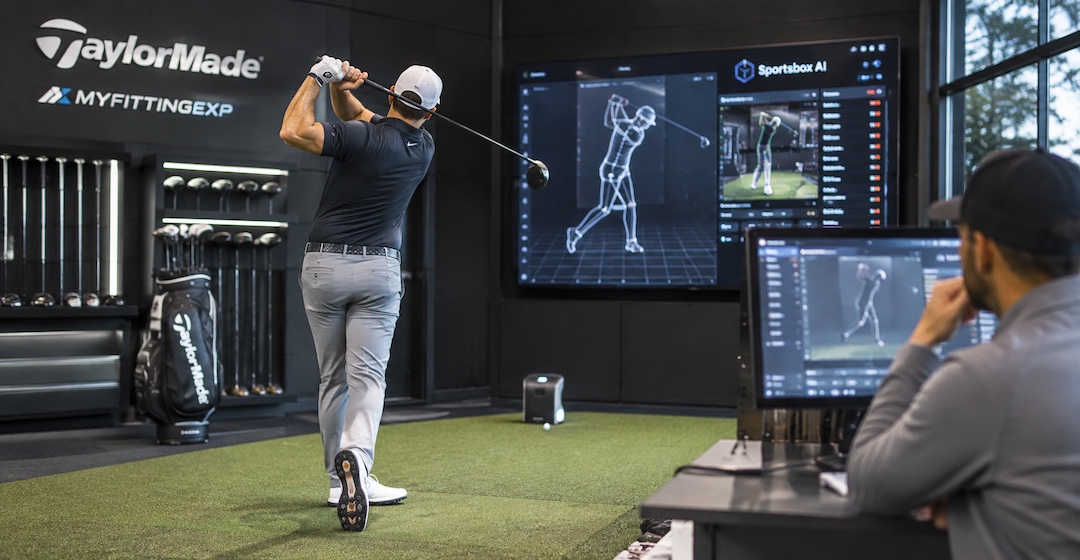
In October, TaylorMade Golf announced a partnership with Sportsbox AI to address that gap.
The companies are integrating Sportsbox's markerless 3D motion-analysis technology into TaylorMade's MyFittingExp platform, combining traditional launch-monitor measurements with biomechanical information about how golfers actually swing.
The technology began rolling out at select TaylorMade fitting experiences on October 12, with broader retail availability planned.
The result is a fitting process that doesn't simply study the shot; it studies the machinery that creates it.
Motion Capture Without the Hollywood Suit
Traditional 3D motion capture has an obvious problem: It's complicated.
For decades, analyzing human movement in three dimensions often meant specialized cameras, reflective markers attached to the body and carefully controlled laboratory environments.
It's the same basic technological world that helped bring digital characters to life in Hollywood and allowed sports scientists to study elite athletes.
Sportsbox AI is attempting to make that kind of analysis dramatically more accessible.
Its technology uses ordinary smartphone video to estimate a golfer's movement in three dimensions without requiring wearable sensors or markers.
Computer-vision algorithms analyze the recorded swing, reconstruct body positions and generate measurements describing how different parts of the golfer move.
Instead of merely watching a two-dimensional video, a fitter can examine a digital representation of the swing and evaluate movement patterns that are difficult to judge consistently with the naked eye.
That matters because golf swings are complex chains of motion.
The pelvis rotates. The torso follows. The arms and hands deliver the club. Small differences in timing and orientation can change how the clubhead approaches the ball.
And the technology doesn't require turning every golf shop into a multimillion-dollar biomechanics facility.
A smartphone becomes the gateway to a sophisticated movement-analysis system.
There are limitations, of course. AI-generated 3D measurements are estimates derived from video, not direct readings from sensors implanted in the body. Camera positioning, image quality and algorithm performance all matter—but the accessibility is the breakthrough.
Technology that once demanded a laboratory can increasingly fit inside a pocket.
The Algorithm Wants to Know How You Rotate
TaylorMade's new approach is particularly focused on driver and shaft fitting.
Its 2026 REAX system organizes golfers into three clubhead-rotation profiles: high, mid and low.
The idea is that different golfers rotate and deliver the club differently, and those characteristics can help inform shaft recommendations.
By incorporating Sportsbox's movement analysis, fitters gain another source of information when identifying those patterns.
Think of it as the difference between tailoring a suit using someone's height and weight versus watching how that person actually moves.
Both approaches collect useful information. One provides considerably more context, while the implications could extend well beyond golf.
Running-shoe companies, bicycle manufacturers, physical therapists and athletic-equipment designers all face variations of the same challenge: matching products to bodies that move differently.
The broader technological shift is toward products designed around individual biomechanics rather than average measurements.
Instead of asking customers to adapt to equipment, manufacturers are developing better ways to adapt equipment to customers.
Golf happens to be an unusually compelling testing ground because tiny differences in movement can produce measurable changes in performance.
The End of the One-Size-Fits-All Golf Swing?
There is a temptation to view every new AI-powered sports technology as a promise that an algorithm will finally discover the perfect technique.
That's not really the point here.
The more interesting possibility is that technology may help establish just how individual athletic movement actually is.
A golfer doesn't necessarily need to swing like a touring professional. The golfer needs equipment that complements the movement they can produce consistently.
That also creates an important distinction between fitting and coaching.
A coach might help change a golfer's mechanics. A fitter is trying to find equipment that works with those mechanics.
Combining biomechanical information with launch-monitor data could help those two disciplines understand each other better.
It won't eliminate the need for experienced fitters, and it certainly doesn't guarantee that a computer-generated recommendation will produce lower scores.
TaylorMade and Sportsbox are introducing another layer of measurement, not a magic formula.
Still, the direction is fascinating as golf spent decades building increasingly sophisticated machines to measure the ball—and now those machines are beginning to turn their attention toward the human body.
The next time you walk into a golf shop, don't be surprised if the person fitting your driver wants to examine your hips, shoulders and rotation before recommending a shaft.
You came in to buy a golf club but you might leave with a biomechanical assessment.
Your Next Golf Club Fitting Might Look Like a Medical Exam
Golf club fitting is becoming a biomechanics lab, with AI and 3D motion capture studying how your body moves to find better equipment that fits your swing.

· 1 day ago
Related Articles

Business
+2
Clubs
Courses

GolfLiving.com Launches Free Golf Community Buyer's Guide
Business

OutingRFP Publishes Free State and Metro Breakdowns of Charity Golf Outings
Business
+2
Clubs
Courses

World Golf Awards 2026: Three International Honors for Piñero’s Real Estate & Golf Division

Jobs
Golf Instructor – IMAGEN Golf
Business
+5
Clubs
Equipment
Products
Technology
Podcast

How Imagen Golf Is Changing the Model for Golf Instruction

Business

Affluent Golfer’s The Garage Finds Another Reason to Enjoy the Drive
Clubs
+2
Equipment
Technology

What is the Bump-and-Run Golf Shot and How Does It Save Strokes?

Tournaments

Custom Coin, Bag Tag and Magnetic Towel for the 2026 Rev Tour East Coast Regional
Business

Affluent Golfer Looks Back on Dennis Hopper, Clint Eastwood and the Stories That Made It Special
Clubs
+3
Equipment
Products
Technology

Why Do Golfers Need to Practice Scrambling to Lower Their Scores?
Clubs
+2
Equipment
Technology
Your Next Golf Club Fitting Might Look Like a Medical Exam
Clubs
+2
Products
Technology

What is a good golf club set for men in 2026?
Business

Affluent Golfer’s Yips & Shanks Salutes the Practice-Range Champion

Apparel
+5
Courses
Equipment
Products
Technology
Podcast

Wise Guys Holiday Gift Guide
Business

Affluent Golfer’s A Round With Makes Room for the Person Behind the Name

Apparel
+9
Business
Clubs
Courses
Equipment
Conferences
Products
Technology
Tournaments
Podcast

The New FLORIDA FAIRWAYS MAGAZINE
Business

Affluent Golfer Plans a Southern California Swing, and Invites Readers Along
Clubs

Affluent Golfer’s Inside the Gates Looks Beyond the Scorecard
Business

Affluent Golfer’s Yips & Shanks Finds the Funny Side of the Fairway
Business

Affluent Golfer Opens Call for Contributors, Celebrity Interviews and Golf Destinations