

There are tens of thousands of golf courses scattered across the planet. Some hug the cliffs of the Pacific Ocean. Others wind through desert canyons, alpine forests or the sprawling suburbs of major cities.
For most of golf's history, playing one required actually going there, but now the planet itself is becoming a software library.
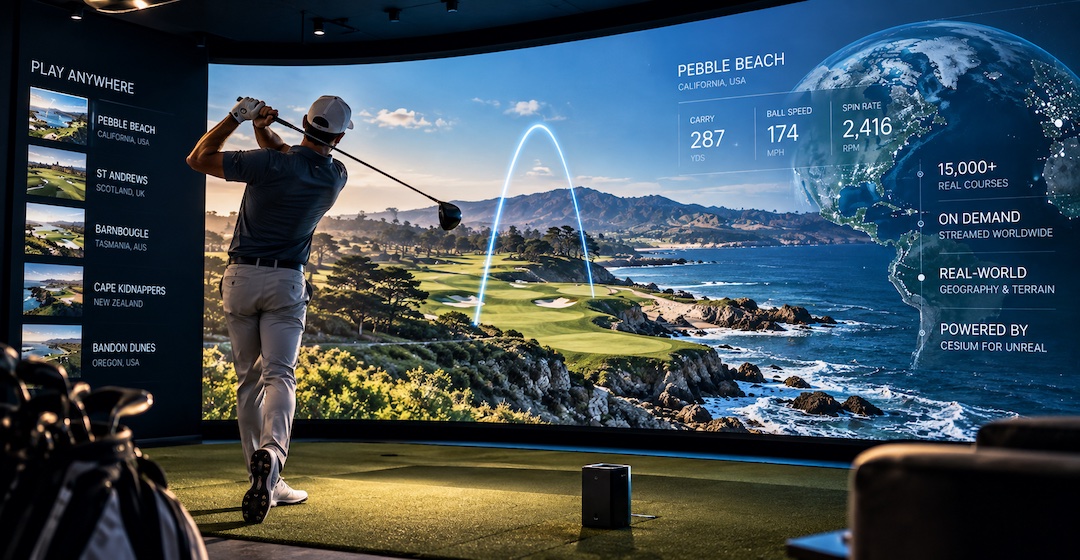
TruGolf recently announced that its E6 golf simulation platform had surpassed 15,000 real-world courses available on demand, a 50-percent increase in less than a year.
That's an enormous virtual golf library. But the more interesting story isn't how many courses the company has added; it's how those courses are being created.
Using geospatial technology called Cesium for Unreal, TruGolf is turning real-world geographic information into playable digital environments. Instead of requiring golfers to download massive collections of individually constructed courses, the software generates environments as they're needed, placing them within their actual geographic surroundings.
It's a development that points toward something considerably bigger than indoor golf; the physical world is becoming playable.
When Google Earth Meets the Game Engine
Traditional golf simulators have generally treated courses like video game levels.
Developers painstakingly recreate fairways, greens, bunkers and surrounding scenery. The finished course becomes a collection of digital assets installed within the simulation software.
It's an effective approach, but scaling it presents an obvious problem as every additional course requires more development work, more data and potentially more storage. Recreating thousands of courses individually becomes a substantial undertaking.
TruGolf's newer approach borrows technology from a different corner of the computing world: geospatial visualization.
Cesium, now part of infrastructure software company Bentley Systems, specializes in making enormous geographic datasets accessible inside three-dimensional applications.
Its Cesium for Unreal technology connects real-world geographic coordinates and streamed 3D terrain with Epic Games' Unreal Engine, the same underlying game-engine technology used to build sophisticated interactive environments.
The result is a system capable of positioning digital objects within geographically accurate surroundings.
That geographic foundation is also supported by TruGolf's partnership with iGolf, whose extensive GPS course-mapping database provides detailed layouts, green geometry and elevation data that help translate real-world golf courses into playable digital environments.
TruGolf combines public and private course datasets with geographic imagery, vegetation and simulation physics. Cesium then streams the surrounding environment as needed, drawing on resources that include Google Photorealistic 3D Tiles and Bing Maps imagery.
A virtual round can therefore include recognizable geography beyond the course boundaries.
Play near Las Vegas and the surrounding cityscape becomes part of the experience. Tee off in Utah and the Wasatch Mountains provide the backdrop.
The course isn't simply floating inside a fictional landscape; it's located somewhere on a digital Earth.
The World Doesn't Need to Fit on Your Hard Drive
There's another important piece of technology making this possible: streaming.
Modern video games have grown notoriously large, sometimes demanding enormous downloads before players can begin—so now imagine applying that model to over 15,000 golf courses.
Even relatively efficient course files would create a daunting storage problem if every environment needed to be installed locally.
TruGolf's system takes a different approach. Course environments are generated at runtime, while the geographic data required for the player's current experience is delivered on demand.
The entire planet doesn't need to live on the computer; only the relevant portion needs to appear when the golfer is playing.
It's conceptually similar to the way online mapping applications allow users to explore enormous geographic areas without downloading every street, building and landscape beforehand—and the approach appears to be gaining traction.
According to TruGolf, on-demand course play increased nearly sixfold year over year. Shots played on those courses rose more than sevenfold, while on-demand courses now account for more than 40 percent of rounds played in E6 Golf 2026.
Those are company-reported figures, but they suggest that golfers are embracing something beyond a handful of familiar virtual destinations; they're exploring and that's a different behavior from repeatedly loading the same championship course.
Golf Is Becoming a Geospatial Application
The broader implications extend beyond entertainment.
Geospatial computing is already transforming architecture, urban planning, construction and infrastructure management. Engineers use digital representations of real environments to visualize projects, examine terrain and understand how physical systems interact.
Golf is beginning to borrow from that same technological foundation, but there's an important distinction between displaying a real place and accurately simulating what happens there.
A satellite image can show where a bunker sits. It cannot, by itself, explain how a golf ball should react when it lands on a particular slope.
Realistic golf simulation still requires carefully processed course geometry, playable surfaces and sophisticated ball physics.
TruGolf combines those elements with streamed geographic surroundings. The result isn't a perfect digital twin of every blade of grass, and golfers shouldn't assume every real-world contour or condition is reproduced exactly; what matters is the direction.
The distinction between a handcrafted virtual environment and a digital representation of an actual place is beginning to narrow—and that opens possibilities beyond simply expanding the course menu.
Imagine virtual golf experiences that evolve as geographic datasets improve. Or platforms where golfers can explore unfamiliar destinations before planning a real trip.
The same technology could eventually support more sophisticated course visualization, training and design applications, and while those possibilities aren't all products available today, the underlying infrastructure is becoming increasingly capable.
The Golf Course Is Turning Into Software
There's a business story here, too. TruGolf says E6 currently supports 19 launch monitors, meaning its expanding course library isn't restricted to customers using the company's own hardware.
That's significant because the value of a simulator may increasingly depend on the software ecosystem rather than the machine measuring the shot.
Launch monitors capture the swing. Simulation software determines where that swing can take you. And a platform offering thousands of real-world destinations creates a very different proposition from one offering a relatively small collection of meticulously recreated courses.
The competition could increasingly revolve around access, variety and how convincingly software represents the world outside.
Of course, virtual golf will never reproduce everything that makes the real game special. A computer cannot recreate the ocean breeze at a coastal course, the smell of freshly cut grass or the particular satisfaction of standing somewhere you've wanted to play for years.
But it can do something remarkable; it can take the geography of the physical world, translate it into an interactive environment and make places thousands of miles apart accessible from the same room.
For decades, golf simulators have tried to make the indoors feel more like the outdoors—the next generation is pursuing something more ambitious.
It's turning the outdoors into software—and suddenly, the entire planet is on the course list.
The Entire Planet Is Becoming a Golf Simulator
Real-world mapping and streaming tech are turning thousands of golf courses into playable 3D digital worlds, bringing the planet itself into the simulator.

· 4 days ago
Related Articles
Business
+2
Courses
Technology

Golf's Next Country Club Might Be an App
Courses
+2
Equipment
Technology
The Entire Planet Is Becoming a Golf Simulator

Tournaments

2026 Solheim Cup Set for Bernardus Golf in the Netherlands
Business
+2
Products
Technology
Golf's Most Important Sensor May Be Hiding in the Grip

Equipment
+1
Products

FootJoy Lab Testing Links Proper Shoe Fit to Measurable Speed Gains
Business
+1
Technology

Golf Tech Is Starting to Measure the Shot Before You Swing

Clubs
+2
Equipment
Technology

What Auditing 3,000 Golf Shaft Specs Taught Us About Weight
Business
+1
Technology

Golf Is Finally Getting Multiplayer Mode, Five Swings at a Time
Equipment
+2
Products
Technology

Golf's Next Computer Is 1.68 Inches Wide
Business
+2
Courses
Technology
The Golf Course Mechanic Is Becoming a Robotics Engineer

Business

LIV Golf Cancels Season Finale, Concerts Amid Operational Breakdown
Business
+1
Technology

Golf's Next Employee Might Just Be an AI Agent

Courses
+2
Tournaments
Podcast

Duff Foreman Could Make History as First Known AI Broadcast Personality to Join a Live Professional Golf Broadcast
Clubs
+2
Equipment
Technology

Golf's "Weirdest" Putters Are Winning the Engineering War

Business
+3
Products
Technology
Tournaments

ParTab Partners with iGolf to Bring Course Intelligence to the Games Golfers Actually Play
Business
+1
Technology

Golf AI Is Learning What Your Scorecard Can’t Tell You

Business
+1
Tournaments

iGolf Partners with Skins Golf to Power Its All-in-One Competitive Golf Platform
Business
+1
Tournaments

LIV Golf Cuts Prize Money Following Cancellation of Team Championship
Courses
+1
Tournaments

Carden Park Secures Women's PGA Cup Hosting Rights

Business
+2
Courses
Tournaments

LIV Golf's Season Finale Plans Scaled Back Amid Uncertainty