

Golf instructors have spent generations telling golfers to loosen their grip.
It's good advice. It's also remarkably imprecise.
How loose? Compared with what? And what happens to that pressure halfway through the downswing, when a golfer is trying to send a small white ball somewhere other than the woods?
For most of golf's history, the answer has been the same: Nobody really knows.
Golf technology can measure clubhead speed, launch angle, spin rate and ball flight with extraordinary precision. Cameras can reconstruct a swing in three dimensions. Artificial intelligence can identify mechanical tendencies that would escape even an experienced instructor.
Yet the physical connection between the golfer and the club remains one of the game's least accessible performance measurements; but that's beginning to change.
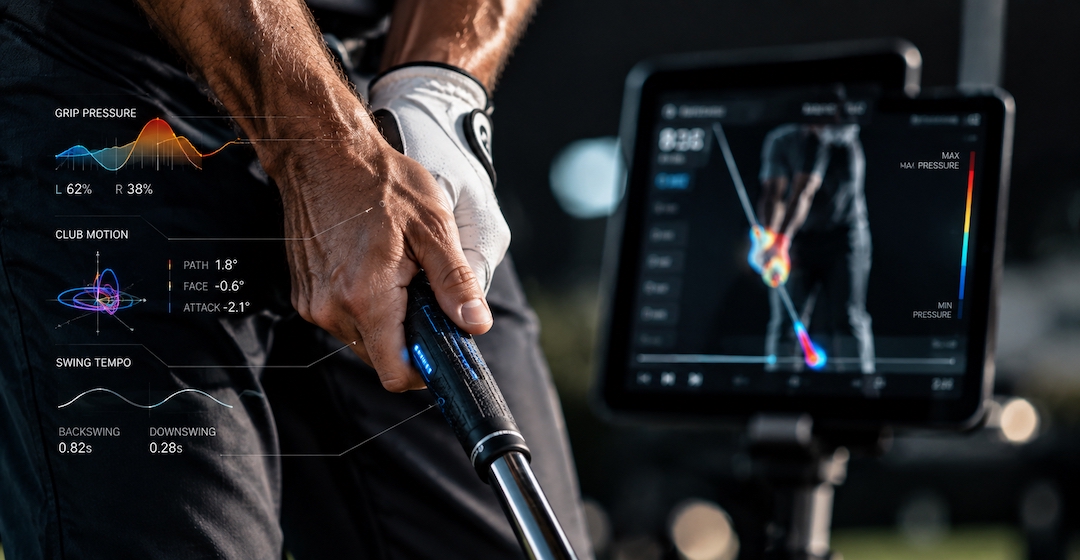
On October 8th, South Korean golf technology company SGLAB launched its G·GRIP Pro crowdfunding campaign, introducing a golf club with pressure sensors, motion tracking and onboard processing built directly into the equipment.
The system is designed to capture how golfers hold the club, how pressure changes throughout the swing and how those changes relate to club movement.
It's an intriguing development in golf's relentless pursuit of better data. Because the next important measurement might not come from watching the golf club move; it might come from understanding how the golfer makes it move.
The Last Great Blind Spot
Consider how much information a modern launch monitor collects during a single swing. Ball speed. Club path. Face angle. Attack angle. Spin axis. Smash factor. Carry distance. The numbers can tell a golfer almost everything about what happened at impact.
What they cannot directly explain is how the golfer's hands behaved during the preceding milliseconds.
Grip pressure is particularly fascinating because it isn't static. The hands continuously adjust their interaction with the club as it accelerates, changes direction and approaches impact.
Research has demonstrated just how individualized those patterns can be.
A 2014 study published in Sports Biomechanics examined grip-force distributions among eight low-handicap golfers using 7-irons and drivers. Researchers found that pressure patterns varied considerably between players but were remarkably repeatable within an individual golfer's swings.
In other words, golfers may possess something resembling a personal grip-pressure signature and that's a potentially valuable distinction.
Traditional instruction often describes an ideal amount of grip pressure. But the more interesting question may be whether a golfer can consistently reproduce the pressure pattern associated with their best swings.
A slightly firmer grip isn't necessarily a mistake. Neither is a lighter one automatically better. The relationship between the hands and the club is considerably more complicated than squeezing less—and that complexity is exactly what makes it worth measuring.
When the Golf Club Becomes the Computer
SGLAB's approach puts the sensing technology inside the club rather than relying on equipment positioned around the golfer.
Its G·GRIP Pro system combines embedded pressure sensors with motion sensors and what the company describes as edge AI processing.
The accompanying application is designed to display grip-pressure maps, reconstruct club movement in three dimensions and compare swing characteristics over time.
The initial Kickstarter offering includes complete 7-iron and putter models, rather than an attachment that golfers can transfer between their existing clubs.
That's an important distinction. This is currently a specialized instrumented club, not a replacement grip that instantly turns an entire set of irons into connected equipment.
It's also a crowdfunded product whose performance claims still need broader independent validation.
Nevertheless, the technological direction is compelling.
Instead of placing a camera behind the golfer or a radar unit beside the ball, the measurement system becomes part of the object being used.
The club effectively develops its own awareness of movement and physical contact and this idea extends far beyond golf.
Engineers increasingly embed sensors into tools, machinery and other physical interfaces to understand how people interact with them. The resulting information can reveal forces and behaviors that external observation alone may miss.
Golf offers a particularly interesting application because the hands are responsible for transferring and managing forces throughout an exceptionally fast, coordinated movement.
A conventional golf grip is essentially a passive component and an instrumented grip becomes a source of information.
The Difference Between Feeling and Knowing
Imagine a golfer who consistently misses approach shots to the right.
A launch monitor identifies an open clubface. Video reveals a mechanical inconsistency. The instructor recommends a grip adjustment.
But what happens next?
Did the golfer actually change how the club was held? Did the pressure shift toward different fingers? Did tension increase during the transition? Did the new grip remain consistent through impact?
Without measurement, much of that evaluation depends on feel and observation.
With reliable grip-pressure data, the instructor could begin comparing the golfer's intentions with what physically occurred.
That doesn't mean a pressure sensor can diagnose every swing fault. Grip forces interact with numerous mechanical variables, and identifying a correlation isn't the same as proving a cause.
But it could give coaches another useful layer of evidence and the putting application may be especially interesting.
Putting is a relatively small movement in which subtle changes in face control and timing can have outsized consequences. Understanding how grip pressure changes during the stroke could provide another way to investigate inconsistencies that aren't obvious on video.
The opportunity isn't simply collecting another statistic; it's connecting a golfer's subjective experience with an objective record.
The Smartest Golf Equipment May Look Ordinary
There are legitimate challenges ahead.
Sensors must remain accurate through repeated impacts. Added electronics cannot meaningfully compromise the club's weight, balance or feel. And the software must translate complicated pressure patterns into information golfers can actually use.
More data doesn't automatically produce better instruction.
Golfers already have enough numbers to turn a recreational round into a laboratory experiment. Another dashboard filled with colorful graphs won't help unless it answers a practical question.
Still, the underlying shift is significant.
Golf technology has spent decades building increasingly sophisticated systems to observe the game from the outside and now the equipment itself is beginning to participate in that observation.
The ball can contain sensors. The golfer can wear sensors. And increasingly, the club can measure what happens at the exact point where human movement becomes mechanical action.
The implications extend beyond whether someone is squeezing a 7-iron too tightly.
They point toward a future in which sporting equipment becomes an intelligent interface between the athlete and the physical world.
For generations, golfers have been told that everything begins with the grip—and now technology may finally be ready to show them why.
Golf's Most Important Sensor May Be Hiding in the Grip
Smart golf grips are turning hand pressure into performance data, revealing the hidden connection between a golfer's hands, club movement and every shot.

· 8 hours ago
Related Articles
Business
+2
Products
Technology
Golf's Most Important Sensor May Be Hiding in the Grip

Equipment
+1
Products
FootJoy Lab Testing Links Proper Shoe Fit to Measurable Speed Gains
Business
+1
Technology
Golf Tech Is Starting to Measure the Shot Before You Swing

Clubs
+2
Equipment
Technology
What Auditing 3,000 Golf Shaft Specs Taught Us About Weight
Business
+1
Technology
Golf Is Finally Getting Multiplayer Mode, Five Swings at a Time
Equipment
+2
Products
Technology
Golf's Next Computer Is 1.68 Inches Wide
Business
+2
Courses
Technology
The Golf Course Mechanic Is Becoming a Robotics Engineer

Business

LIV Golf Cancels Season Finale, Concerts Amid Operational Breakdown
Business
+1
Technology

Golf's Next Employee Might Just Be an AI Agent

Courses
+2
Tournaments
Podcast

Duff Foreman Could Make History as First Known AI Broadcast Personality to Join a Live Professional Golf Broadcast
Clubs
+2
Equipment
Technology

Golf's "Weirdest" Putters Are Winning the Engineering War

Business
+3
Products
Technology
Tournaments

ParTab Partners with iGolf to Bring Course Intelligence to the Games Golfers Actually Play
Business
+1
Technology

Golf AI Is Learning What Your Scorecard Can’t Tell You

Business
+1
Tournaments

iGolf Partners with Skins Golf to Power Its All-in-One Competitive Golf Platform
Business
+1
Tournaments

LIV Golf Cuts Prize Money Following Cancellation of Team Championship
Courses
+1
Tournaments

Carden Park Secures Women's PGA Cup Hosting Rights

Business
+2
Courses
Tournaments

LIV Golf's Season Finale Plans Scaled Back Amid Uncertainty
Equipment
TaylorMade Adds Hi-Toe 5 Wedge to Growing Wedge Portfolio
Business
+2
Products
Technology
Your Apple Watch Is Coming for Your Golf Watch
Business
+1
Tournaments

LIV Golf's Bedminster Event Draws Trump, Surfaces Mystery Investor