

For years, golf simulators were defined by what they could replicate.
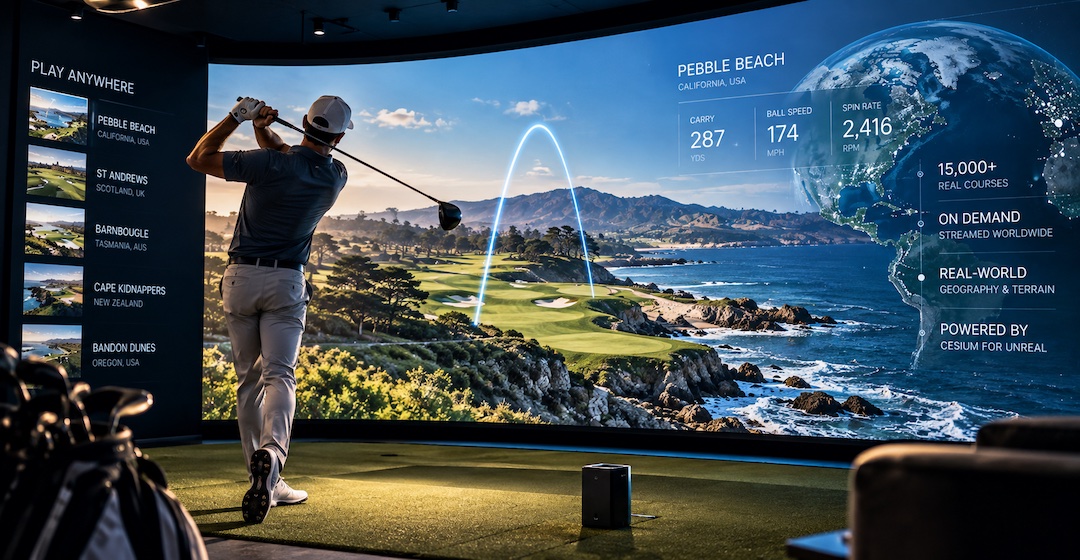
Pebble Beach in your basement. St. Andrews on a projector screen. A digital version of the game that lets golfers play anywhere, anytime, regardless of weather or daylight.
That was the pitch.
But in early 2026, something more interesting is happening. Simulators are no longer trying to replicate golf—they’re starting to interpret it.
What was once a visualization tool is evolving into something closer to an intelligent training system, powered by artificial intelligence, advanced sensors and a growing layer of software designed to turn raw data into real improvement.
And the shift is happening quickly.
From Data Machines to Decision Engines
Modern simulators have always been good at collecting data. Ball speed, launch angle and spin rate—metrics that once lived exclusively inside Tour vans and fitting studios—are now available in garages and indoor facilities.
But data alone has limits.
The challenge isn’t collecting numbers. It’s understanding them.
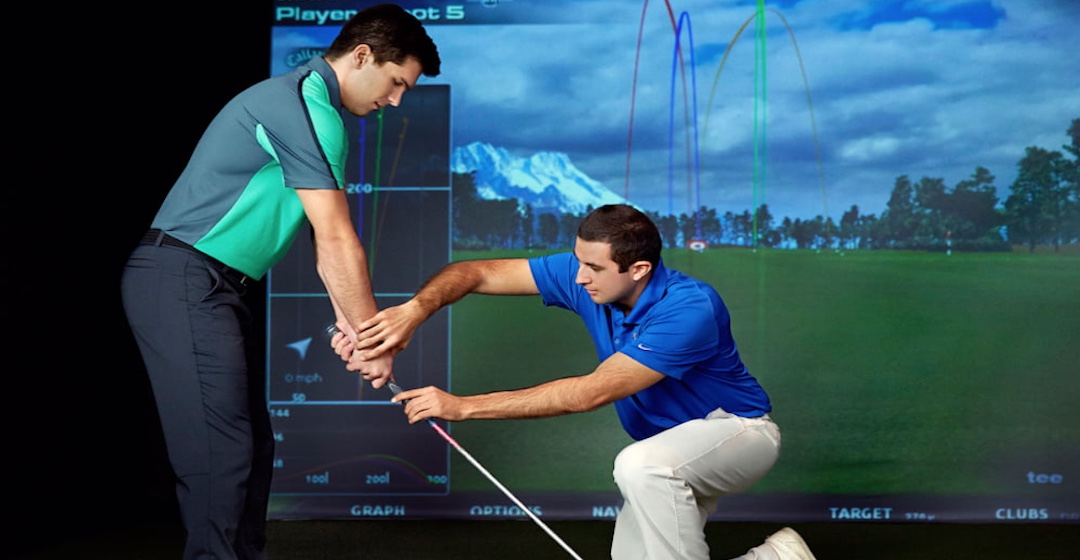
That’s where AI is beginning to reshape the category. Instead of simply displaying metrics, newer systems are interpreting them in real time, identifying patterns, diagnosing issues and offering suggestions for improvement. The difference is subtle but important. A launch monitor can tell you your club path is three degrees out-to-in. An intelligent system begins to explain why that’s happening—and what to do about it.
That shift from measurement to interpretation is defining the next phase of golf technology.
The Rise of the Coaching Layer
Across the simulator landscape, a new concept is quietly emerging: the coaching layer.
It sits on top of existing hardware—launch monitors, cameras and motion sensors—and transforms those inputs into feedback loops that guide player behavior. Instead of practicing blindly, golfers are beginning to interact with systems that track tendencies over time, recognize patterns in ball flight and swing mechanics, and offer suggestions that feel more like guidance than raw data.
The goal is no longer just accuracy. It’s usability.
In early 2026, that’s becoming the true point of differentiation. Not which system collects the most data, but which system can make that data meaningful. The technology is beginning to close the gap between information and action, turning practice sessions into something more intentional and structured.
Hardware Is Catching Up to Software
At the same time, hardware continues to evolve, though it’s no longer the headline story.
Camera-based systems are becoming more prominent, with multi-camera setups capturing club path, face angle and impact conditions at high frame rates. These systems feed enormous amounts of data into software engines that simulate ball flight and analyze swing mechanics with increasing precision.
But hardware alone is no longer enough.
Accuracy still matters—especially at the high end—but the real competition is shifting toward software. User experience, training tools and the ability to translate data into insight are becoming the defining characteristics of modern systems.
It’s a familiar pattern. Smartphones stopped competing on hardware specs years ago. Now they compete on ecosystem and experience. Golf technology is following the same trajectory.
The Consumer Electronics Moment
Another force accelerating this shift is price.
As competition increases across the launch monitor and simulator space, costs are coming down while capabilities continue to expand. Systems are becoming more portable, more intuitive and easier to integrate into everyday routines.
That combination—better and cheaper—is what transforms niche technology into something mainstream.
Launch monitors were once luxury tools. Simulators were reserved for commercial facilities or high-end home builds. Now both are inching toward becoming standard equipment for serious amateurs.
Golf technology is entering its consumer electronics phase, where accessibility matters just as much as innovation.
The Indoor Practice Revolution
All of this is converging into a larger shift in how golfers train.
Golf will always be played outdoors, but the practice environment is increasingly moving inside. Indoor spaces offer a level of control and consistency that traditional ranges simply can’t match. Conditions don’t change with the weather. Data remains consistent from session to session. Feedback is immediate and measurable. And perhaps most importantly, access is no longer limited by daylight or seasonal constraints.
When those factors combine with AI-driven analysis, the result is a fundamentally different kind of practice experience. Instead of hitting balls and relying on feel, players can test adjustments in real time, see measurable results and iterate quickly.
Improvement becomes less about guesswork and more about feedback.
The Bigger Shift
What makes this moment interesting isn’t just the technology itself. It’s what the technology is replacing.
For generations, golf improvement has relied on repetition, intuition and occasional instruction. Players would hit balls, make adjustments based on feel and hope those changes translated to the course.
Now, that model is being augmented by systems that provide continuous guidance.
The coach isn’t disappearing, but it’s being supported by an always-on layer of intelligence that sits between the player and the swing. And unlike traditional instruction, it scales effortlessly.
Every swing becomes part of a larger dataset. Every session builds on the last.
Where It’s Heading
If early 2026 is any indication, the trajectory is clear.
Simulators will continue to get smarter. Launch monitors will become more integrated into broader systems. And AI will become less visible, even as its influence grows.
The line between playing and training will continue to blur, as practice environments become more immersive and more analytical at the same time.
The future of golf technology isn’t just about collecting better data.
It’s about making better decisions.
And increasingly, those decisions are being shaped long before the golfer even steps onto the course.
Simulators Are Becoming Golf's Smartest Coach
AI is transforming golf simulators into intelligent coaching systems, turning raw data into real-time feedback and redefining how players practice and improve.

· 7 months ago
Related Articles
Business
+2
Courses
Technology

Golf's Next Country Club Might Be an App
Courses
+2
Equipment
Technology
The Entire Planet Is Becoming a Golf Simulator

Tournaments

2026 Solheim Cup Set for Bernardus Golf in the Netherlands
Business
+2
Products
Technology
Golf's Most Important Sensor May Be Hiding in the Grip

Equipment
+1
Products
FootJoy Lab Testing Links Proper Shoe Fit to Measurable Speed Gains
Business
+1
Technology
Golf Tech Is Starting to Measure the Shot Before You Swing

Clubs
+2
Equipment
Technology

What Auditing 3,000 Golf Shaft Specs Taught Us About Weight
Business
+1
Technology
Golf Is Finally Getting Multiplayer Mode, Five Swings at a Time
Equipment
+2
Products
Technology
Golf's Next Computer Is 1.68 Inches Wide
Business
+2
Courses
Technology
The Golf Course Mechanic Is Becoming a Robotics Engineer

Business

LIV Golf Cancels Season Finale, Concerts Amid Operational Breakdown
Business
+1
Technology

Golf's Next Employee Might Just Be an AI Agent

Courses
+2
Tournaments
Podcast

Duff Foreman Could Make History as First Known AI Broadcast Personality to Join a Live Professional Golf Broadcast
Clubs
+2
Equipment
Technology

Golf's "Weirdest" Putters Are Winning the Engineering War

Business
+3
Products
Technology
Tournaments

ParTab Partners with iGolf to Bring Course Intelligence to the Games Golfers Actually Play
Business
+1
Technology

Golf AI Is Learning What Your Scorecard Can’t Tell You

Business
+1
Tournaments

iGolf Partners with Skins Golf to Power Its All-in-One Competitive Golf Platform
Business
+1
Tournaments

LIV Golf Cuts Prize Money Following Cancellation of Team Championship
Courses
+1
Tournaments

Carden Park Secures Women's PGA Cup Hosting Rights

Business
+2
Courses
Tournaments

LIV Golf's Season Finale Plans Scaled Back Amid Uncertainty