

Golf has always been a game of individual pieces.
A driver in one hand. A rangefinder in the other. Maybe a GPS watch clipped to your wrist and a launch monitor waiting in the trunk.
Each gadget served a purpose, but they largely lived in their own worlds.
A driving-range session stayed on the range. A simulator round stayed inside the simulator. A lesson with your instructor often began from scratch because yesterday's data lived somewhere else, but that world is disappearing.
In 2026, golf technology is undergoing one of its most significant transformations yet—not because devices are becoming dramatically smarter, but because they're finally beginning to communicate with one another.
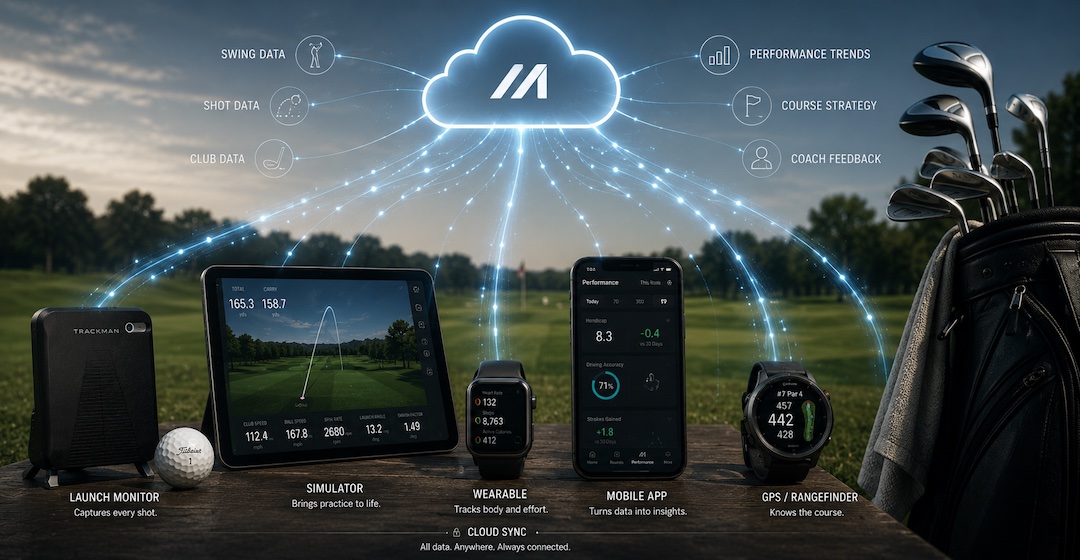
Launch monitors are syncing with simulator platforms. Wearables feed data into mobile apps. AI analyzes months of performance across multiple devices. Cloud-based profiles follow golfers from the practice range to the first tee and back home again.
The story isn't about another gadget; it's about the network connecting all of them.
From Standalone Devices to Connected Systems
For years, golf technology evolved in silos.
A GPS watch knew how far you were from the green, but it knew nothing about your swing. A launch monitor measured ball flight, but rarely connected that information to your on-course performance. Simulators produced mountains of data that often remained trapped inside their own software ecosystems.
Every product solved its own problem, but very few solved golf as a whole and that's beginning to change.
Manufacturers increasingly understand that golfers don't experience the game through isolated devices. A practice session influences tomorrow's round. A club fitting affects simulator performance. Lessons shape on-course decisions. The modern golfer moves fluidly between environments, and technology is finally evolving to move with them.
Instead of selling standalone hardware, companies are building ecosystems—and ecosystems are always more powerful than individual products.
The Cloud Is Becoming Golf's Memory
One of the biggest shifts is happening somewhere golfers never actually see; the cloud.
Every swing, practice session and round of golf can now contribute to a growing digital history that follows players regardless of where they practice or which device they're using.
A golfer might hit balls with a portable launch monitor on Tuesday, play an indoor simulator league on Thursday and walk eighteen holes with a GPS watch on Saturday. Ten years ago, those experiences existed independently.
Today, they're increasingly connected.
Performance trends accumulate over weeks and months rather than individual sessions. AI systems recognize recurring tendencies across multiple environments. Equipment changes become easier to evaluate because historical baselines already exist.
Instead of isolated snapshots, golfers are building complete performance profiles.
The technology remembers; even when the golfer doesn't.
Hardware Is Becoming the Gateway
This evolution represents a fundamental change in how golf companies think, but the hardware (obviously) still matters.
Launch monitors continue getting faster. GPS watches become lighter. Simulators grow more realistic. But increasingly, the device itself is simply the entry point into a much larger software experience.
This mirrors what happened across consumer technology.
Smartphones stopped competing solely on cameras and processors years ago. Today, the ecosystem matters just as much as the hardware. Cloud syncing, connected apps, software updates and seamless integration have become the real differentiators.
Golf is following that exact roadmap.
The best launch monitor isn't necessarily the one with the most sensors; it's the one that fits naturally into everything else you already use.
AI Connects the Dots
Artificial intelligence is accelerating this transition in ways that weren't possible just a few years ago.
Individual devices generate enormous amounts of information. AI gives that information context.
A launch monitor may notice driver spin increasing. A wearable device recognizes fatigue during later holes. A simulator identifies recurring impact patterns. Separately, those observations are useful—together, they become insight.
That's where connected ecosystems begin outperforming standalone devices.
Artificial intelligence doesn't simply analyze one practice session anymore; it analyzes a golfer.
Over time, software starts recognizing habits, identifying trends and surfacing recommendations based on everything it has learned across every connected platform.
The experience becomes increasingly personalized—not because one device is exceptionally intelligent, but because every device contributes to the same growing picture.
The Future Doesn't Feel Like Technology
Perhaps the most fascinating part of this evolution is how invisible it becomes.
Golfers won't spend more time thinking about technology; they'll spend less.
Sessions will sync automatically. Firmware updates will arrive quietly overnight. Performance histories will update in the background. Devices will exchange information without requiring constant setup or manual input.
The technology fades into the experience and that's often the hallmark of mature innovation.
The earliest generations of golf gadgets demanded attention. They required setup, calibration and interpretation. The next generation is quietly removing those layers, allowing golfers to focus less on operating technology and more on playing golf.
That's a surprisingly profound shift, because the best technology rarely announces itself—it simply works.
A Connected Future
Golf has always been a sport built on incremental improvement.
Connected technology follows that same philosophy.
No single device will suddenly transform a golfer overnight. No AI platform will replace thoughtful practice or sound instruction. But when launch monitors, simulators, wearables, GPS systems and mobile software begin working together, they create something much larger than the sum of their parts.
They create continuity—and continuity may become golf's greatest competitive advantage in the years ahead.
For decades, golf technology was measured by how much information it could collect.
The next generation will be judged by how effortlessly it connects everything golfers already do.
The future of golf isn't another gadget—it's an ecosystem quietly learning alongside every swing.
Golf Is (Finally) Entering Its Connected-Device Era
Connected golf tech is uniting launch monitors, simulators, wearables and AI into one seamless ecosystem that transforms how golfers practice and play.

· 3 months ago
Related Articles
Business
+1
Technology
Golf Tech Is Starting to Measure the Shot Before You Swing

Clubs
+2
Equipment
Technology
What Auditing 3,000 Golf Shaft Specs Taught Us About Weight
Business
+1
Technology
Golf Is Finally Getting Multiplayer Mode, Five Swings at a Time
Equipment
+2
Products
Technology
Golf's Next Computer Is 1.68 Inches Wide
Business
+2
Courses
Technology
The Golf Course Mechanic Is Becoming a Robotics Engineer

Business

LIV Golf Cancels Season Finale, Concerts Amid Operational Breakdown
Business
+1
Technology

Golf's Next Employee Might Just Be an AI Agent

Courses
+2
Tournaments
Podcast

Duff Foreman Could Make History as First Known AI Broadcast Personality to Join a Live Professional Golf Broadcast
Clubs
+2
Equipment
Technology

Golf's "Weirdest" Putters Are Winning the Engineering War

Business
+3
Products
Technology
Tournaments

ParTab Partners with iGolf to Bring Course Intelligence to the Games Golfers Actually Play
Business
+1
Technology

Golf AI Is Learning What Your Scorecard Can’t Tell You

Business
+1
Tournaments

iGolf Partners with Skins Golf to Power Its All-in-One Competitive Golf Platform
Business
+1
Tournaments

LIV Golf Cuts Prize Money Following Cancellation of Team Championship

Courses
+1
Tournaments

Carden Park Secures Women's PGA Cup Hosting Rights

Business
+2
Courses
Tournaments

LIV Golf's Season Finale Plans Scaled Back Amid Uncertainty
Equipment
TaylorMade Adds Hi-Toe 5 Wedge to Growing Wedge Portfolio
Business
+2
Products
Technology
Your Apple Watch Is Coming for Your Golf Watch
Business
+1
Tournaments

LIV Golf's Bedminster Event Draws Trump, Surfaces Mystery Investor

Equipment
+1
Products
Titleist Equipment Wins 2026 Wyndham Championship with Michael Brennan
Business
+2
Equipment
Products
Callaway and Acushnet Report Q2 Revenue Gains Across Core Segments