

For generations, the driving range has been golf's laboratory.
Not in the scientific sense, but in the way golfers have always experimented. A new grip. A different ball position. One more swing thought borrowed from a magazine or the lesson taken last week. Bucket after bucket, players chased improvement through repetition, hoping somewhere between the first ball and the last, something would click.
It was a process built largely on feel, but in 2026, feel is no longer the only variable.
The modern practice range is quietly evolving into one of the most technology-rich environments in sports, where nearly every swing can be measured, analyzed and refined in real time. Launch monitors, artificial intelligence, connected mobile apps and cloud-based performance platforms are transforming what was once little more than a patch of grass into something that increasingly resembles a research facility.
Golf's oldest practice ground is becoming a data lab.
Every Swing Is Becoming an Experiment
One of the biggest changes isn't the hardware itself—it's the philosophy behind practice.
For decades, golfers judged improvement almost entirely by ball flight. A shot looked better. It felt more solid. Maybe it flew a little farther. That visual feedback was often enough.
Today, every swing can produce a digital fingerprint.
Portable launch monitors now capture ball speed, carry distance, launch angle, spin characteristics, club speed and dispersion within seconds. Instead of relying solely on eyesight, golfers can verify exactly what happened after impact and compare it against previous swings or entire practice sessions.
The result is a subtle but profound shift in mindset. Rather than simply hitting golf balls, players are testing hypotheses.
What happens if the ball moves one inch farther forward? Does a flatter takeaway actually reduce spin? Is that swing change producing more speed, or does it only feel faster?
Questions that once required guesswork now have measurable answers. Practice is becoming an exercise in experimentation.
Data Without the Complexity
Early launch monitor technology was incredibly powerful—but it wasn't particularly welcoming.
The devices produced mountains of information, much of it aimed at instructors, club fitters and elite players who already understood how to interpret advanced performance metrics.
Today's systems are taking a different approach.
Artificial intelligence is increasingly acting as a translator, filtering complex datasets into recommendations golfers can actually use. Instead of overwhelming players with dozens of numbers, software identifies patterns, highlights meaningful changes and surfaces the insights that matter most.
The technology is beginning to think more like a coach than a calculator; that's an important distinction.
Collecting data is relatively easy. Knowing which data deserves attention—and which can safely be ignored—is where artificial intelligence is starting to separate itself.
Golfers aren't becoming statisticians—they're becoming better decision-makers.
The Practice Session Never Really Ends
Perhaps the biggest transformation isn't happening on the driving range at all; it's happening after golfers leave.
Modern launch monitors increasingly sync with cloud platforms, allowing every practice session to become part of a much larger performance history. Instead of treating each visit to the range as an isolated event, software builds long-term profiles that reveal trends impossible to spot during a single afternoon of practice.
A golfer may discover that driver spin gradually increases late in sessions. Iron distances might improve over several months while wedge consistency remains unchanged. Certain swing adjustments may consistently produce better results, while others quietly disappear without lasting improvement.
The practice range is no longer just a place, it's becoming a database—and that continuity changes how improvement happens.
Rather than chasing daily swing fixes, golfers begin recognizing longer-term patterns. Progress becomes something measured over weeks and months instead of buckets and afternoons.
The Democratization of Tour-Level Practice
Professional golfers have operated this way for years. Tour players routinely practice with launch monitors, biomechanics specialists and performance teams interpreting every shot. Data has long been part of elite golf.
The difference in 2026 is accessibility.
Portable launch monitors have become smaller, faster and considerably more affordable. What once required specialized indoor studios can now fit inside a golf bag. Many systems pair wirelessly with smartphones, providing detailed analysis within seconds of impact.
The gap between professional and recreational practice is shrinking.
Not because amateur golfers suddenly have identical technology, but because they now have access to many of the same concepts that were previously available only at the highest levels of the game.
The tools are becoming democratized—and that's changing expectations. Golfers increasingly arrive at the range expecting measurable feedback instead of simple repetition.
The Future Is Built on Understanding
For all the advancements in launch monitors, sensors and artificial intelligence, one thing remains remarkably unchanged.
Golf is still incredibly difficult and technology doesn't eliminate bad swings or guarantee lower scores. It can't replace discipline, patience or countless hours of thoughtful practice. What it can do is remove uncertainty.
The best golf technology isn't trying to replace instinct; it's helping golfers understand it.
That may be the most important evolution happening in the game today. Practice is becoming less about blindly searching for improvement and more about building a repeatable process supported by meaningful information.
The golfer still swings the club, but increasingly, the technology explains why that swing succeeded—or why it didn't.
And as launch monitors, AI and connected software continue to evolve, the humble driving range is becoming something entirely different from what previous generations knew. Not just a place to hit golf balls.
A place where every swing becomes a data point, every adjustment becomes an experiment and every practice session contributes to a smarter understanding of the game.
The driving range hasn't changed—the way golfers use it has.
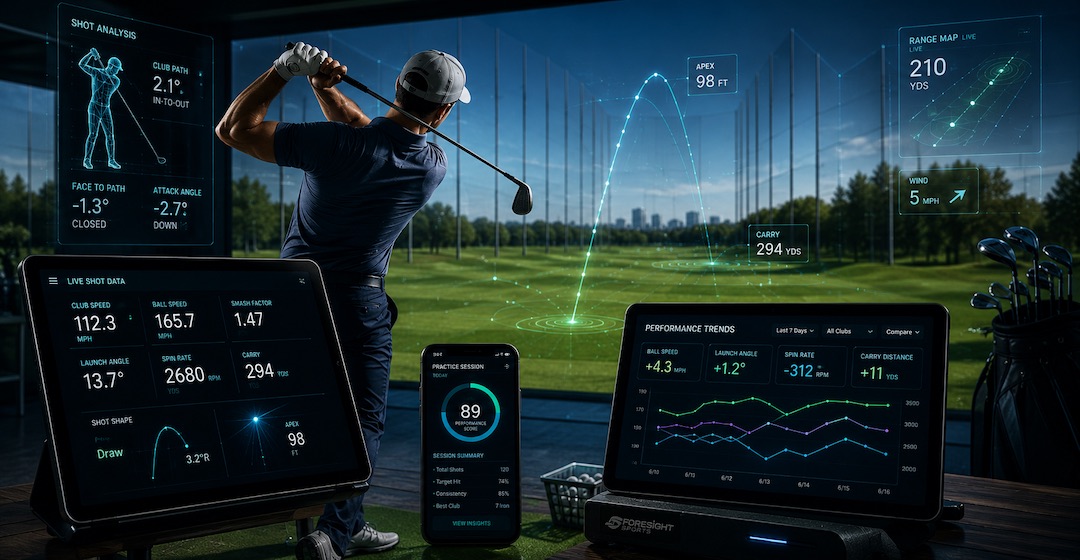
The Practice Range Is Becoming a Data Lab
Modern driving ranges are becoming data labs, where AI, launch monitors and connected software transform every practice session into measurable improvement.

· 3 months ago
Related Articles
Business
+1
Technology
Golf Tech Is Starting to Measure the Shot Before You Swing

Clubs
+2
Equipment
Technology

What Auditing 3,000 Golf Shaft Specs Taught Us About Weight
Business
+1
Technology
Golf Is Finally Getting Multiplayer Mode, Five Swings at a Time
Equipment
+2
Products
Technology
Golf's Next Computer Is 1.68 Inches Wide
Business
+2
Courses
Technology
The Golf Course Mechanic Is Becoming a Robotics Engineer

Business

LIV Golf Cancels Season Finale, Concerts Amid Operational Breakdown
Business
+1
Technology

Golf's Next Employee Might Just Be an AI Agent

Courses
+2
Tournaments
Podcast

Duff Foreman Could Make History as First Known AI Broadcast Personality to Join a Live Professional Golf Broadcast
Clubs
+2
Equipment
Technology

Golf's "Weirdest" Putters Are Winning the Engineering War

Business
+3
Products
Technology
Tournaments

ParTab Partners with iGolf to Bring Course Intelligence to the Games Golfers Actually Play
Business
+1
Technology

Golf AI Is Learning What Your Scorecard Can’t Tell You

Business
+1
Tournaments

iGolf Partners with Skins Golf to Power Its All-in-One Competitive Golf Platform
Business
+1
Tournaments

LIV Golf Cuts Prize Money Following Cancellation of Team Championship

Courses
+1
Tournaments

Carden Park Secures Women's PGA Cup Hosting Rights

Business
+2
Courses
Tournaments

LIV Golf's Season Finale Plans Scaled Back Amid Uncertainty
Equipment

TaylorMade Adds Hi-Toe 5 Wedge to Growing Wedge Portfolio
Business
+2
Products
Technology
Your Apple Watch Is Coming for Your Golf Watch
Business
+1
Tournaments

LIV Golf's Bedminster Event Draws Trump, Surfaces Mystery Investor

Equipment
+1
Products
Titleist Equipment Wins 2026 Wyndham Championship with Michael Brennan
Business
+2
Equipment
Products
Callaway and Acushnet Report Q2 Revenue Gains Across Core Segments